Table of Contents
ToggleIntroduction: Boot Loop After Opencore Update
Boot loops on unsupported Macs Can be super frustrating, especially after updating OpenCore Legacy Patcher. These loops often happen because OpenCore updates tweak system files and EFI settings, which can conflict with older hardware or unsupported macOS versions.
Unsupported Macs behave differently during updates, making them more prone to startup errors, crashes, or endless reboot cycles. That’s why keeping backups of your EFI folder, config.plist, and macOS snapshots is so essential; they act like a safety net, letting you restore your Mac quickly and avoid being stuck in a frustrating boot loop.
What Causes a Boot Loop After OpenCore Legacy Patcher Update
Boot loops after updating OpenCore Legacy Patcher are one of the most common headaches for users with unsupported Macs. They happen when the system can’t complete the boot process, often due to conflicts in EFI, system files, or hardware limitations. Understanding the leading causes helps you troubleshoot effectively and decide whether a snapshot revert, config restore, or EFI tweak is the best solution.
What changes during an OpenCore Legacy Patcher update
Every OpenCore update modifies system files, boot arguments, and EFI settings to support newer macOS versions on older Macs. These changes, while intended to improve compatibility, can accidentally clash with your existing configuration. Even minor updates can trigger reboot loops if a patch conflicts with your hardware or previous EFI setup.
What EFI modifications trigger repeated reboot cycles
EFI modifications are a common culprit behind boot loops. Issues such as missing drivers, incorrect ACPI patches, or misconfigured kexts can prevent the Mac from completing the boot sequence. Ensuring a stable EFI folder and double-checking your config.plist before applying updates can save you from endless reboots.
What role do macOS snapshots play in boot failures?
APFS snapshots are like time machines for macOS. If an OpenCore update fails or overwrites crucial files, a snapshot rollback can restore your system to a working state. Without snapshots, recovering from a failed update becomes tricky and may require a complete reinstall of macOS.
What hardware incompatibilities worsen startup loops
Older Macs may have hardware limitations that cause them to struggle with newer macOS updates. Incompatible GPUs, unsupported Wi-Fi or Bluetooth chips, or insufficient RAM can all trigger boot loops. Recognizing your Mac’s limitations before applying OpenCore updates can prevent frustrating startup failures.
Understanding Boot & Startup Errors on Unsupported Macs
Boot and startup errors on Unsupported Macs happen more often because these machines aren’t officially supported for newer macOS versions. OpenCore acts as a bridge to make the system compatible, but small misconfigurations or hardware limitations can cause loops, freezes, or crashes. Understanding how OpenCore interacts with the system helps you pinpoint the source of startup problems.
How OpenCore interacts with the macOS boot sequence
OpenCore modifies the macOS boot process to allow unsupported Macs to load the operating system. It injects drivers, patches ACPI, and manages kexts to mimic supported hardware. If any of these modifications fail or conflict with your Mac’s EFI setup, the boot process can halt or restart continuously.
How NVRAM, SMC, and EFI affect startup stability
NVRAM stores boot preferences, SMC controls low-level hardware functions, and EFI contains the boot loader and drivers. Problems with any of these can directly lead to boot loops.
- Corrupted NVRAM can prevent the Mac from remembering boot arguments.
- SMC issues may cause power or sensor-related errors.
- A misconfigured EFI folder or a config.plist can completely break the boot sequence.
How boot loops differ from black screen and kernel panic
Boot loops, black screens, and kernel panics may look similar but have different causes.
- Boot loop: Mac keeps restarting without fully loading macOS.
- Black screen: Display issue or GPU incompatibility prevents visuals during startup.
- Kernel panic: macOS detects a critical system error, often due to incompatible kexts or drivers.
- Recognizing the difference helps you choose the proper fix, whether it’s a snapshot revert, an EFI restore, or an NVRAM reset.
Identifying Symptoms of an OpenCore Boot Loop
Recognizing the signs of a boot loop is the first step to fixing it. OpenCore boot loops can show up in different ways depending on your Mac model, configuration, and the type of update applied. Spotting these symptoms early can save time and help you decide whether a snapshot revert or config restore is needed.
Mac restarting after the Apple logo
One of the most common symptoms is your Mac restarting repeatedly right after/ or Stuck at the Apple Logo appears. This usually happens when the EFI configuration or boot arguments conflict with system files. Even if it briefly shows the Apple logo, it never fully loads macOS.
Endless progress bar during macOS boot
If your Mac gets stuck on the progress bar for a long time, it’s often because an update failed or incompatible kexts are present. This indicates the system is trying to load macOS but cannot complete the process. Sometimes the progress bar may appear frozen, then the Mac restarts automatically.
Reboot loop after the login screen.
In some cases, the Mac passes the Apple logo and even the login screen, only to reboot repeatedly after entering your password. This typically points to corrupted user settings, incompatible drivers, or a misconfigured EFI folder.
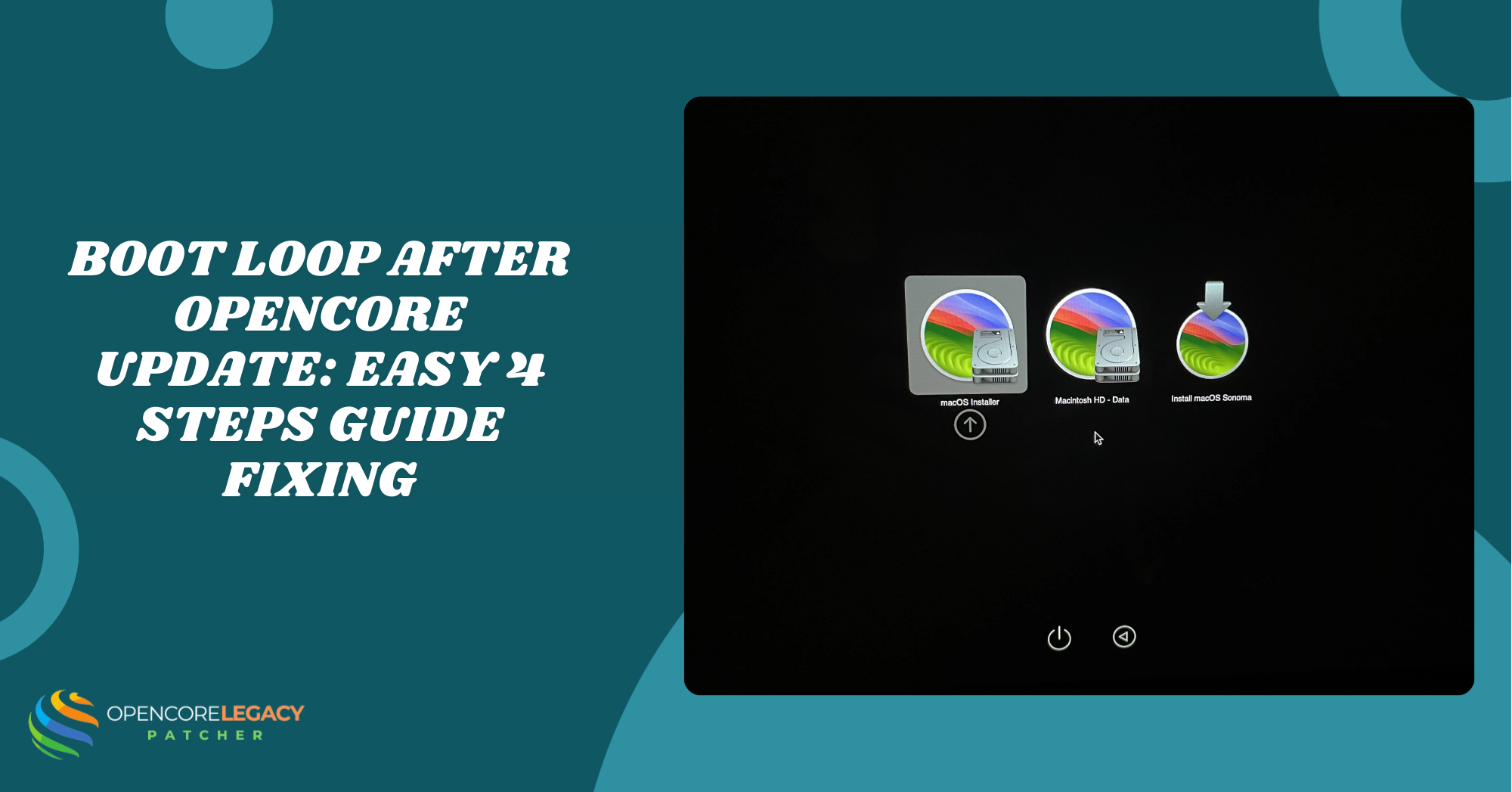
Boot picker is loading, but macOS is failing
Sometimes the OpenCore boot picker appears normally, allowing you to select macOS, but the system fails to boot afterward. This usually means the EFI or config.plist isn’t matching your Mac model, or the recent update broke some essential boot patches.
- Ensuring your boot picker is correctly configured can prevent this symptom.
- Restoring a backup EFI folder often fixes this issue.
Snapshot Revert Method to Fix Boot Loop
When your Mac gets stuck in a boot loop after Installing the Latest Version of OpenCore Legacy Patcher, using a snapshot revert is one of the safest ways to fix it. Snapshots are like little backups of your system that let you roll back to a time when everything was working perfectly. This approach saves you from reinstalling macOS or losing apps and settings.
How APFS snapshots work in macOS
APFS snapshots create a frozen copy of your system at a specific point in time. They keep all files, settings, and apps intact so you can restore your Mac exactly as it was. If an update causes problems, you can return to this snapshot to avoid startup errors and boot loops.
How to revert a macOS snapshot from Recovery
To restore a snapshot:
- Start your Mac in Recovery Mode by holding Command + R.
- Open Terminal and type tmutil listlocalsnapshots / to see available snapshots.
- Pick the snapshot you want and run tmutil restore to roll your system back.
This quickly restores your Mac to a stable state without affecting your personal files.
How snapshot rollback fixes OpenCore update issues
A snapshot rollback reverses any changes made during the update, including EFI tweaks and system patches. It restores your Mac to a working setup, preventing the endless restart cycle that often happens after a failed OpenCore update.
When snapshot restore is the safest option
Snapshot restore is ideal when:
- Your Mac keeps restarting or freezes after an update.
- EFI or config.plist changes have caused boot errors.
- You want a fast fix without reinstalling macOS or losing data.
It’s a simple, reliable method that fixes boot loops without affecting anything else.
Config Restore to Recover From OpenCore Update Failure
Restoring your Mac’s configuration is one of the most reliable ways to fix boot loops after an OpenCore Legacy Patcher Update. When an update goes wrong, your EFI folder or config.plist may no longer match your system, causing repeated restarts. By restoring previous backups, you can quickly and safely restore your Mac to a stable state.
How to restore the previous EFI backup
Restoring a previous EFI folder is often the fastest way to recover from boot issues. Replace the current EFI folder on your USB or internal drive with a backup that worked before the update. This ensures that all drivers, kexts, and patches are restored to a known-working state, preventing the Mac from entering an endless loop.
How to replace config.plist safely
Replacing a misconfigured config.plist requires care:
- Always keep a copy of the current config.plist before replacing it.
- Use a verified backup from before the update.
- Ensure that the new config matches your Mac model and OpenCore version.
Doing this correctly prevents startup errors and keeps your system stable.
How mismatched config causes startup errors
A mismatch in the config.plist can prevent macOS from booting correctly. Incorrect SMBIOS settings, wrong boot arguments, or missing kexts may trigger boot loops, freezes, or kernel panics. Even minor changes can prevent OpenCore from loading the OS, so restoring the correct config is essential for a smooth startup.
How to validate config using OpenCore tools
OpenCore provides tools to check your configuration before booting:
- OC Configurator and ProperTree can highlight errors in config.plist.
- Built-in validators help ensure SMBIOS, drivers, and patches match your system.
- Testing the config in a controlled environment prevents failed updates from causing boot loops.
Using these tools ensures your restored configuration is safe and ready for macOS startup.
Booting Into macOS Recovery When Stuck in Boot Loop
When your Mac is trapped in a boot loop after an OpenCore update, macOS Recovery becomes your best friend. Recovery mode lets you troubleshoot, revert snapshots, or restore your EFI without entirely booting into the system. Knowing how to access and use it on unsupported Macs can save hours of frustration.
How to access Recovery with OpenCore installed
To enter Recovery with OpenCore, restart your Mac and immediately hold Command + R. OpenCore may also allow you to select the Recovery partition from its boot picker. Once loaded, you can access macOS utilities, Terminal, and snapshot tools to safely start fixing the boot loop.
How to use Recovery on unsupported Macs
Unsupported Macs often require OpenCore to reach Recovery. After selecting the Recovery partition, you can use Disk Utility to repair drives, Terminal to manage snapshots, or reinstall macOS if needed. This environment gives you control even when normal booting fails.
How to mount EFI from the Recovery environment
Sometimes you need to access the EFI folder directly in Recovery. Open Terminal and use commands like diskutil list to locate your EFI partition, then diskutil mount /dev/diskXsY to mount it. Once mounted, you can restore a backup EFI folder or edit config.plist to fix startup errors without booting macOS.
NVRAM and SMC Reset to Resolve Startup Loop
If your Mac keeps restarting after an OpenCore Legacy Patcher update, the problem might be stored system settings or power management issues. NVRAM and SMC store critical information that your Mac uses to start up and manage hardware. Resetting them often stops boot loops without affecting your personal files or requiring a macOS reinstall.
How NVRAM corruption causes boot loops
NVRAM stores settings such as startup disk preferences, screen resolution, and boot arguments. When it becomes corrupted, your Mac can’t start properly, leading to repeated restarts. Clearing NVRAM removes these old or broken settings, giving your Mac a clean slate to boot successfully.
How to reset NVRAM on Intel Macs
Here’s a safe way to reset NVRAM on Intel Macs:
- Turn off your Mac completely.
- Hold Option + Command + P + R while powering it on.
- Keep holding the keys for about 20 seconds, then release.
- This clears outdated boot settings and can stop boot loops caused by misconfigured NVRAM.
How SMC reset helps power-related boot errors
The SMC manages hardware functions like power, battery, fans, and thermal sensors. Problems here can lead to freezes, unexpected shutdowns, or boot loops. Resetting the SMC refreshes these settings, helping your Mac manage hardware properly and often resolving startup issues caused by power misbehavior.
Safe Mode and Verbose Mode for Boot Loop Diagnosis
Safe Mode and Verbose Mode are potent tools for troubleshooting why your Mac is stuck in a boot loop after an OpenCore Legacy Patcher update. Safe Mode limits what loads during startup, while Verbose Mode displays real-time messages that help pinpoint where the boot process fails. Using these modes together can make troubleshooting much faster and less stressful.
How Safe Mode limits problematic extensions
Safe Mode starts your Mac with only essential system processes and disables most third-party drivers or extensions. This prevents incompatible kexts or patches from causing boot loops. If your Mac boots successfully in Safe Mode, it usually points to a problematic driver or extension that needs attention.
How Verbose Mode reveals OpenCore boot errors
Verbose Mode displays detailed messages on the screen as your Mac boots. Instead of hiding what’s happening behind a progress bar, you can see where the system hangs or fails. This is especially useful for detecting OpenCore-related issues, misconfigured kexts, or EFI problems during startup.
How to identify failing kexts during startup
While in Verbose Mode, look for repeated errors or lines that stop progressing; these often indicate failing kexts.
- Note the exact names of the kexts or drivers causing errors.
- Compare them with your EFI configuration to spot mismatches.
- Once identified, you can remove or replace problematic kexts to restore normal boot behavior.
Rebuilding OpenCore Legacy Patcher Correctly
When an OpenCore update causes a boot loop, rebuilding OpenCore from scratch is often the safest fix. Starting fresh helps eliminate corrupted files, misconfigured drivers, or outdated patches that could prevent your Mac from booting. A careful rebuild ensures your system is stable and ready to work with unsupported hardware.
How to rebuild OpenCore after an update failure
To Rebuild/Restore Mac after OpenCore safely:
- Back up your current EFI folder before making changes.
- Use the latest OpenCore Legacy Patcher to generate a new EFI tailored to your Mac.
- Replace old drivers and kexts with the correct versions.
- This approach restores a clean, functioning boot environment without carrying over problematic files.
How to select the correct Mac model and SMBIOS
Choosing the right Mac model and SMBIOS is essential for proper booting:
- Pick a model that closely matches your Mac’s hardware.
- Make sure SMBIOS settings are compatible with your macOS version.
- Wrong settings can cause kernel panics, startup errors, or hardware misbehavior.
- Correct selection ensures OpenCore can manage system patches and hardware efficiently.
How to apply post-install root patches safely
Post-install root patches fix compatibility issues after installing macOS on unsupported Macs. Apply them carefully:
- Use only patches recommended for your macOS version.
- Avoid applying conflicting patches together.
- Verify the patches before rebooting to prevent new boot issues.
- This ensures your Mac runs smoothly without triggering another boot loop.
Preventing Boot Loops After Future OpenCore Updates
Preventing boot loops before they happen is always easier than fixing them after the fact. By taking a few simple precautions, you can keep your Mac stable and avoid recurring startup issues. Backups, careful testing, and version checks are key to smooth updates on unsupported Macs.
How to create EFI and snapshot backups
Backups act as a safety net if an update fails. Save a copy of your EFI folder to an external drive, and create an APFS snapshot of your macOS system. These backups let you quickly restore your Mac to a working state without losing apps or data, keeping your system protected from unexpected boot problems.
How to test updates before the central installation
Before applying updates to your central system, test them on a secondary drive or partition. This allows you to check if all kexts, drivers, and patches work correctly. Only proceed with the central system once you are sure the update is stable, minimizing the risk of boot loops.
How to avoid incompatible macOS and OCLP versions
Using incompatible versions is a common cause of boot failures. Check which macOS and OpenCore Legacy Patcher versions work with your Mac model. Avoid updates that require unsupported patches, and read release notes carefully to prevent startup errors and maintain system stability.
Conclusion
Boot loops after an OpenCore Legacy Patcher update can feel stressful, but they are usually fixable with the right approach. Using snapshot reverts, restoring EFI backups, resetting NVRAM or SMC, and carefully managing updates can quickly get your Mac back to a stable state.
Preventive steps like keeping backups, testing updates safely, and ensuring compatibility will save you time and headaches in the future. With these strategies, even unsupported Macs can run smoothly and reliably without constant boot issues.
Frequently Asked Questions – Boot Loop After OpenCore Legacy Patcher Update
Why does my Mac enter a boot loop after updating OpenCore Legacy Patcher?
Boot loops usually happen when the update changes EFI settings, drivers, or kexts in ways your Mac cannot handle. Conflicting patches, misconfigured config.plist, or hardware limitations can all prevent macOS from booting correctly.
What is the fastest fix for an OpenCore boot loop without reinstalling macOS?
The quickest solutions are restoring a previous EFI backup, reverting an APFS snapshot, or booting into Safe Mode to isolate problematic extensions. These methods often fix startup loops without touching your personal files.
Can reverting an APFS snapshot fix startup errors after the OCLP update?
Yes! APFS snapshots let you roll back your Mac to a point before the update. This restores system files, settings, and EFI configurations, usually resolving boot loops caused by failed or conflicting updates.
Is restoring an old EFI folder safe for unsupported Macs?
Absolutely. Replacing a broken EFI with a previously working backup is safe and effective. It restores all necessary drivers, kexts, and OpenCore settings, helping unsupported Macs boot normally again.
Does a wrong config.plist cause continuous reboot issues?
Yes. Misconfigured config.plist files with wrong SMBIOS, boot arguments, or kext settings can prevent the Mac from completing startup. Restoring a correct config is often key to fixing repeated restarts.
Can NVRAM reset fix OpenCore boot and startup errors?
In many cases, yes. Resetting NVRAM clears corrupted boot settings, startup disk preferences, and other stored configurations that can cause boot loops, allowing your Mac to start fresh.
Should I downgrade OpenCore Legacy Patcher to stop boot looping?
Downgrading can work if a recent update is causing conflicts. However, it’s safer to restore a working EFI and config or revert snapshots first, as these preserve your Mac’s stability without risking compatibility issues.
How can I prevent boot loops before installing future OpenCore updates?
Always back up your EFI folder and create an APFS snapshot before updating. Test updates on a secondary drive, and ensure your macOS and OpenCore versions are compatible with your Mac model. These steps reduce the risk of startup failures.
Latest posts: