Table of Contents
ToggleIntroduction:
Apple’s release of a new operating system is always an exciting time for Mac users. With the arrival of macOS 16, widely referred to as macOS Tahoe, users are eager to experience the latest features, security updates, and UI refinements. However, as with every major update, Apple has dropped support for several older Intel-based Macs, leaving many loyal users behind.
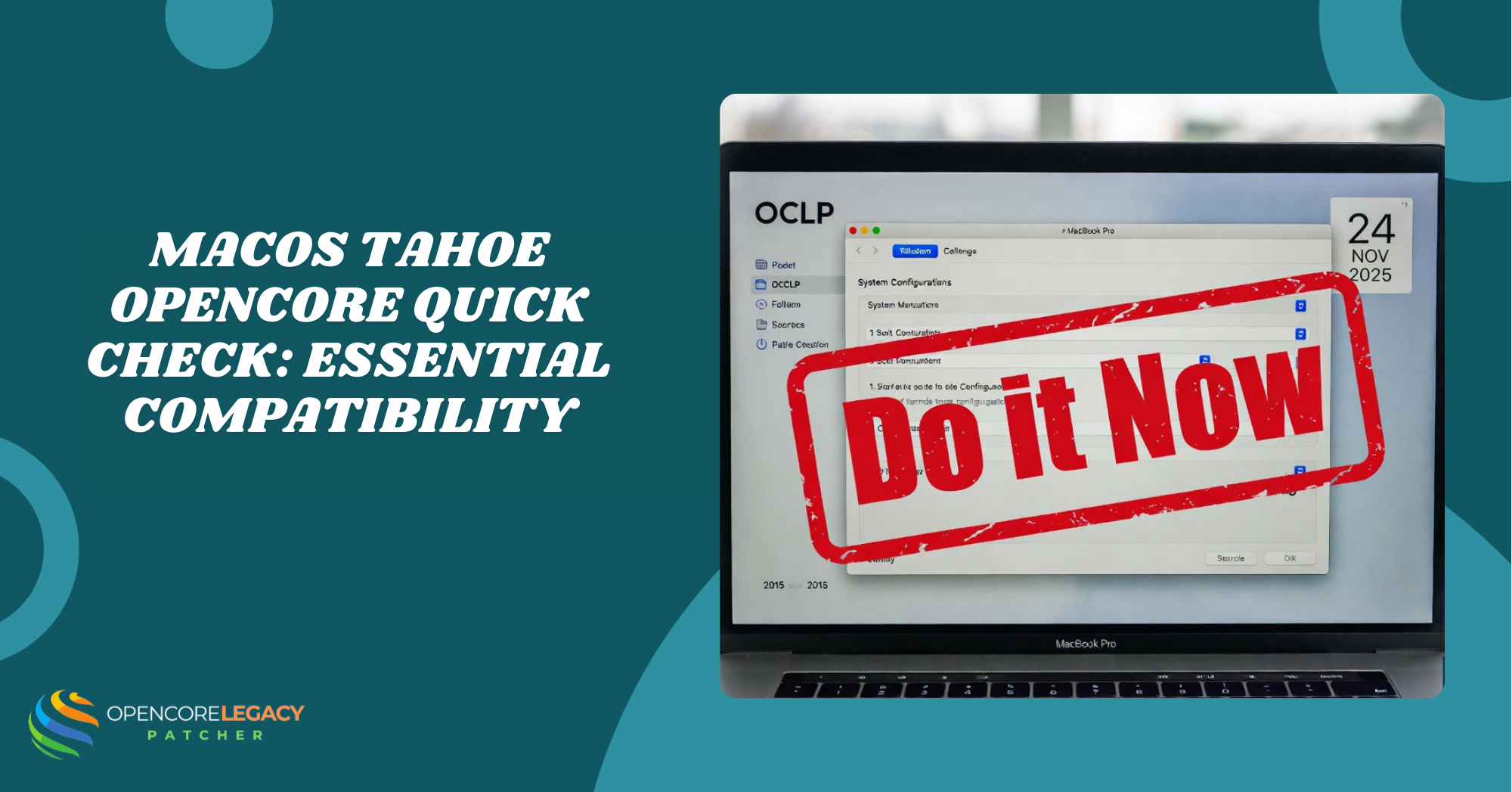
If you own an older device, you might be asking: Is macOS Tahoe OpenCore Legacy Patcher support available? Can I breathe new life into my vintage machine?
The short answer is yes but with caveats. The OpenCore Legacy Patcher (OCLP) team is constantly working to bridge the gap between modern software and legacy hardware. In this comprehensive guide, we will explore OCLP macOS Tahoe compatibility, provide a step-by-step guide to install macOS Tahoe on old Mac hardware, and discuss whether it is safe for your daily driver.
What is OpenCore Legacy Patcher (OCLP)?
Before diving into the installation process, it is essential to understand the tool that enables it. OpenCore Legacy Patcher is a sophisticated, community-driven project that enables unsupported macOS Tahoe installations.
Apple restricts new macOS versions to specific hardware IDs (mostly Apple Silicon M-series and recent Intel chips). OCLP bypasses these checks. It injects necessary drivers (kexts) and patches the kernel in memory, tricking the operating system into thinking it is running on supported hardware.
However, running the latest OS on decade-old hardware is a complex feat. It requires not just installation, but also “root patching” to fix graphics acceleration, Wi-Fi, and Bluetooth support.
OCLP macOS Tahoe Compatibility: Supported Models
The biggest question on everyone’s mind is compatibility. Which Macs can actually run Tahoe via OCLP?
While the official list evolves with every OCLP update, the general rule is that if your Mac could run macOS Sonoma or Sequoia via OCLP, it has a high probability of running Tahoe. However, patching macOS Tahoe on Intel Macs is becoming harder as Apple removes legacy Intel code.Supported Categories:
* MacBook Pro: Late 2012 to 2019 (Intel models dropped by Apple).
* MacBook Air: Mid 2012 to 2019.
* iMac: Late 2012 to 2019.
* Mac mini: Late 2012 to 2018.
* Mac Pro: 2013 (Trashcan) and older classic Cheese Grater towers (with Metal GPU upgrades).
Important Note: Non-Metal GPUs (pre-2012) face significant graphical glitches. For the best experience, your Mac should ideally support the “Metal” graphics API.
Step-by-Step: How to Install macOS Tahoe on an Old Mac
Ready to upgrade? This section guides you through the process of updating MacOS With OpenCore Legacy Patcher. We will create a macOS Tahoe bootable USB and install the OS on your unsupported machine.
Prerequisites
Before you begin, ensure you have the following:
1. USB Drive: A USB flash drive with at least 16GB (32GB recommended) of storage.
2. Backup: Time Machine or manual backup. This is critical.
3. Download: The latest version of the OpenCore Legacy Patcher app.
4. Stable Internet: To download the 12GB+ macOS installer.
Step 1: Download the macOS Tahoe Installer
You cannot download Tahoe from the App Store on an unsupported Mac. Instead, use OCLP:
1. Open the OpenCore Legacy Patcher app.
2. Click on “Create macOS Installer.”
3. Select “Download macOS Installer.”
4. Choose macOS Tahoe from the list and let it download.
Step 2: Create a macOS Tahoe Bootable USB
Once the download finishes, you need to turn your USB stick into a bootable drive.
1. Insert your USB drive.
2. In OCLP, select “Create macOS Installer” again.
3. Choose “Use Existing macOS Installer” and select the Tahoe file you just downloaded.
4. Select your USB drive as the target.
5. Click “Flash”. This will erase the drive and copy the installation files.
Step 3: Build and Install OpenCore
This is the magic step. You must install the OpenCore bootloader onto the USB drive so the Mac can boot from it.
1. Go back to the OCLP main menu.
2. Click “Build and Install OpenCore.”
3. Click “Install to Disk” and select your USB drive (not your hard drive yet!).
4. Once finished, reboot your Mac.
Step 4: Boot and Install
1. Hold down the Option (Alt) key immediately while your Mac restarts.
2. You will see a boot picker screen. Select the icon labelled “EFI Boot” (with the OCLP logo).
3. Next, select “Install macOS Tahoe.”
4. Follow the standard Apple installation prompts. Select your main hard drive as the destination.
Note: The computer may restart several times. This is normal.
Step 5: Post-Install Root Patching
After the installation finishes, your Mac might look slow, or the dock might be transparent. This is because graphics drivers are missing.
1. Open the OCLP app (you may need to copy it to your Applications folder first).
2. It should automatically detect that you need patches.
3. Click “Post-Install Root Patch.”
4. Click “Start Root Patching.”
5. Reboot when prompted.
Congratulations! You have successfully installed macOS Tahoe on old Mac hardware.
Is OCLP Tahoe Safe or Not?
This is a vital question for anyone using their Mac for work or school. Is the OCLP Tahoe safe for a daily driver?
The Reality of “Hackintosh” Methods
Technically, using OCLP turns your real Mac into a “Hackintosh.” You are modifying system files to force compatibility.
Security: Generally safe. OCLP utilises Apple’s own security protocols where possible, but you often have to partially disable SIP (System Integrity Protection) for the root patches to work.
Stability: This depends on your specific model. A 2015 MacBook Pro will likely run Tahoe very smoothly. A 2011 Mac mini might struggle.
Updates: You cannot blindly click “Update” in System Settings. You must usually update the OCLP app before applying minor macOS updates (e.g., 16.1 to 16.2).
Recommendation
If this is your only computer and you cannot afford downtime, proceed with caution. However, for secondary machines or savvy users, OCLP is widely considered safe and reliable by the community.
Common Tahoe Installation Problems and Fixes
Even with a perfect guide, things can go wrong. Here are the most common Tahoe installation problems and how to solve them.
1. Stuck on Apple Logo (Boot Loop)
If your Mac hangs halfway through the progress bar, it is usually a verbose error hidden behind the logo.
Fix: Reboot and hold Option. Reset NVRAM/PRAM. Ensure you built OpenCore for the correct model ID in the OCLP settings. and Make sure you are using the Latest Version Of OCLP.
2. Tahoe Root Patch Issues
Sometimes, after updating, you might lose Wi-Fi or graphics acceleration.
Fix: This is one of the most frequent Tahoe root patch issues. Open the OCLP app, check for updates to the patcher itself, and re-run the “Post-Install Root Patch.” Reboot immediately.
3. “Bluetooth Not Available”
Legacy Bluetooth modules often lose support in newer macOS versions.
* Fix: OCLP usually patches this automatically. If it fails, you may need to reset the Bluetooth module via Terminal or buy a USB Bluetooth dongle compatible with macOS.
4. Banking Apps Crashing
Some high-security apps detect that the system has been modified (SIP disabled).
Fix: Unfortunately, this is a trade-off. Some strict banking or enterprise apps may not work on a patched system.
Performance: Is It Worth It?
Just because you can install macOS Tahoe on old Mac devices doesn’t always mean you should.
The “Metal” Requirement
Apple’s interface relies heavily on the Metal graphics API.
Metal-supported Macs (2012+): Will generally run Tahoe smoothly. Animations will be fluid, and transparency effects will work.
Non-Metal Macs (2011 and older): The OCLP team does miracles to make these work, but you may experience graphical glitches, Photos app crashes, or Maps issues.
If you are just browsing the web and writing documents, performance is usually indistinguishable from that of a supported Mac. However, heavy video editing or 3D rendering on a 2013 machine running Tahoe will be slow not because of the patcher, but because the hardware is ageing.
Alternatives for Unsupported Macs
If you find that the macOS Tahoe OpenCore Legacy Patcher process is too technical or risky for your taste, you have other options.
1. Stay on macOS Monterey or Ventura
Older versions of macOS still receive security updates for years. If your apps still work, there is no urgent need to upgrade.
2. Linux or Windows
Turning an old Mac into a Linux machine or installing Windows 10/11 via BootCamp can actually make it run faster than modern macOS.
3. Hardware Upgrade
Eventually, the gap between the hardware and software becomes too wide. If you need the latest features for professional work, consider upgrading to an Apple Silicon (M1/M2/M3) Mac.
Frequently Asked Questions (FAQ)
To cover everything you need to know about OCLP macOS Tahoe compatibility, we’ve compiled the most common questions from the community.
Can I update macOS Tahoe normally through System Settings?
Yes and no. You can see the updates in System Settings, but you should never update without checking the OCLP app first. Always update the OpenCore Legacy Patcher app to the latest version before applying a macOS system update. If you don’t, you risk losing Wi-Fi or keyboard drivers after the restart.
Will iServices like iMessage, FaceTime, and iCloud work?
Yes, for the vast majority of users, iServices work perfectly. OpenCore is designed to preserve valid serial numbers and hardware UUIDs. However, if you have messed with your serial number manually in the config settings, you might face authentication issues.
Does OCLP slow down my Mac?
OCLP itself does not slow down your Mac; it is merely a bootloader. However, running a modern OS like macOS Tahoe on 10-year-old hardware requires more RAM and CPU power than older versions like macOS Mojave. We strongly recommend having at least 8GB of RAM and an SSD (Solid State Drive) before upgrading.
Is this process reversible?
Yes. If you find that unsupported Mac macOS Tahoe performance is poor, you can downgrade. However, you cannot simply “uninstall” OCLP. You will need to wipe your hard drive and reinstall your original macOS version using a standard bootable USB or Internet Recovery. Always back up your data!
Why is my Wi-Fi not working after installing Tahoe?
This is a classic example of Tahoe root patch issues. Apple removed the drivers for older Wi-Fi cards in newer macOS versions. OCLP puts them back, but the patch must be reapplied after every OS update. Open the OCLP app, run the “Post-Install Root Patch,” and restart your Mac.
Conclusion
The macOS Tahoe OpenCore Legacy Patcher is a testament to the dedication of the developer community. It keeps perfectly functional hardware relevant, reducing e-waste and saving users money.
While installing macOS Tahoe on older Mac devices involves a learning curve, the result is often a fully functional, modern machine. Just be mindful of potential Tahoe root patch issues and ensure you keep your data backed up.
If you are willing to tinker, an unsupported macOS Tahoe installation is not just possible—it’s a fantastic way to extend the life of your premium Apple hardware.
Ready to start? Download the latest OpenCore Legacy Patcher today, grab a 16GB USB drive, and give your old Mac the upgrade it deserves!